The Only 10 Pieces of Gear Every Beginner Camper Actually Needs

Reading Time-12 minutes-Skill
Level-Complete Beginner
Budget Range$300 – $700
"Go on the internet looking for camping gear and you'll find 147 items claiming to be essential. Almost none of them are. Here is what you actually need."
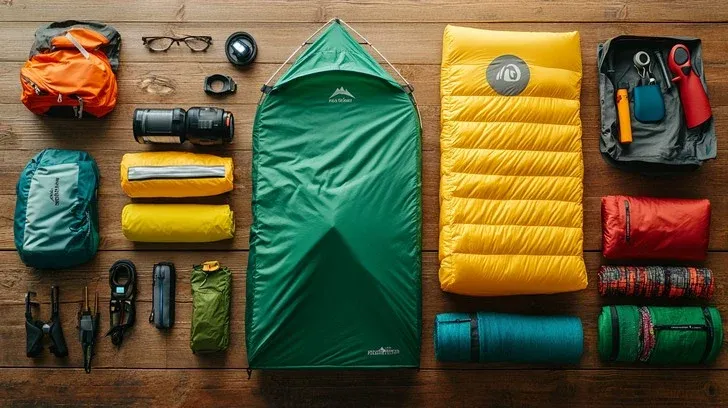
01 · Tent 02 · Sleeping Bag 03 · Sleeping Pad 04 · Headlamp 05 · Camp Stove 06 · Water Filtration 07 · First Aid Kit 08 · Multi-Tool 09 · Layering System 10 · The Right Pack
Walk into any outdoor gear shop for the first time and you will leave either overwhelmed or broke — probably both. The wall of options is enormous, the price tags alarming, and every salesperson has a different opinion on what you absolutely cannot survive without. Trekking pole grips. Ultralight titanium sporks. A three-hundred-dollar sleeping bag stuffed with ethically sourced goose down from birds that apparently lived better lives than most people do.
Here is the honest truth that the gear industry doesn't particularly want you to know: you need very little to have an extraordinary first camping trip. The fundamentals haven't changed much in decades. Shelter. Warmth. Light. Fire. Water. Safety. Everything else is comfort, convenience, or — let's be real — a very tempting way to spend money you didn't plan to spend. This list gives you the ten things that actually matter, why each one matters, what to look for, and what a reasonable budget looks like.
Start here. Buy smart. Go outside. You can always add more gear later — and you will, because once camping gets into you, it never fully leaves.
01 · Essential⛺
The Tent
Your Home in the Wild — Choose It Carefully⬡ Budget range: $80 – $250 for a solid beginner option
The tent is where everything starts and ends. It's your shelter from rain, your protection from wind, your barrier against insects, and — on a psychological level — the thing that makes the wilderness feel survivable to someone who has never slept under nylon before. Get this right, and nearly everything else becomes easier.
For a first-time camper, a three-season tent is the move. It handles spring, summer, and fall conditions — the three seasons most beginners are camping in — and it does so without the weight penalty and extra cost of a full four-season winter tent you almost certainly don't need yet. Look for a freestanding design, meaning the tent holds its shape on its own without relying entirely on stakes. This makes setup dramatically easier, especially in the dark, on rocky ground, or when you're genuinely exhausted at the end of a long first day.
Pro Tip
Always buy a tent rated for two more people than will actually sleep in it. A "4-person" tent with two people in it means room to actually move, sit up, and store gear inside. A "2-person" tent with two people is a very intimate and deeply uncomfortable experience.
Before your first trip, practice setting it up at home. In your backyard, in your living room, wherever. Tent setup gets dramatically easier after the third or fourth time, and you do not want your first time to be at dusk in a strange place after a long drive. The tent footprint — a ground sheet that goes underneath — is worth adding. It protects the tent floor from abrasion and moisture wicking up from the ground, extending the life of your tent considerably.
02 · Essential🛏️
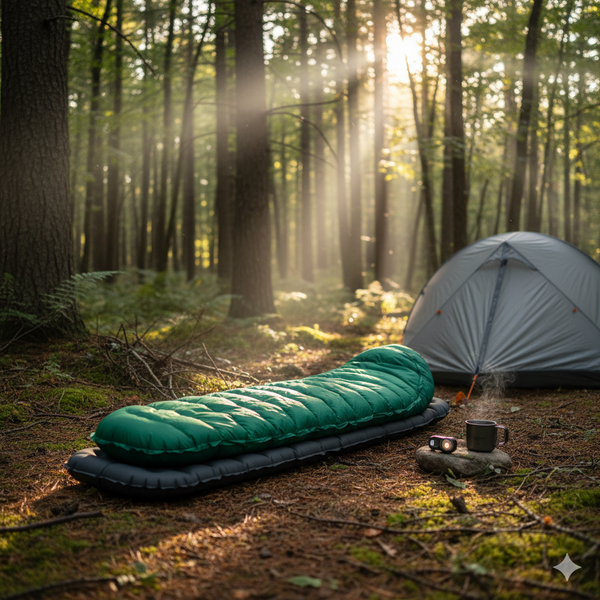
The Sleeping Bag
Temperature Ratings Are Not Suggestions⬡ Budget range: $60 – $180 for a reliable three-season bag
A cold night in a sleeping bag rated for warmer temperatures is one of the most miserable experiences camping has to offer. It's not dramatically dangerous for most healthy adults in mild conditions — it's just sleep-ruining, morale-destroying, and the single most common reason people decide camping "isn't for them" after one attempt. Don't let a $40 bag make that decision for you.
Sleeping bag temperature ratings tell you the lowest temperature at which the bag is designed to keep you alive — not comfortable. In practice, add about 10 degrees Fahrenheit of warmth to whatever the bag claims. A bag rated to 32°F will keep you alive at 32°F; it will keep you comfortable at around 42°F. A 20°F bag is genuinely versatile for three seasons across most of North America, since nights in the wilderness almost always run significantly colder than the daytime high suggests.
Down vs Synthetic
Down bags compress smaller and are warmer for their weight, but are useless when wet and expensive to replace. Synthetic bags are heavier and bulkier but retain warmth even when damp and are much easier to care for. For beginners: synthetic. You can upgrade later.
Mummy-style bags (tapered to your body shape) are warmer and more efficient than rectangular bags, which let cold air pool at your feet. If you share a tent with a partner, rectangular bags can zip together — but if sleeping warm is the priority, mummy bags win every time.
03 · Essential🟩
The Sleeping Pad
The Most Overlooked Essential in All of Camping⬡ Budget range: $30 – $120 depending on type
This is the piece of gear beginners skip most often, and it is a mistake they make exactly once. The sleeping pad does two completely different jobs, and both of them are critical. First, obviously, it provides cushioning. The ground is hard. Even soft earth has roots, rocks, and lumps in places that become agonizingly obvious around 2 a.m. But the second job of the sleeping pad is the one most people don't know about: insulation from the ground.
Your sleeping bag insulates by trapping warm air in loft — the fluffy space in the fill. When you lie on it, you compress that loft completely, stripping the insulation from the side of you touching the ground. The pad is what stands between you and conductive heat loss to the earth, which is cold all year round regardless of air temperature. A warm sleeping bag on bare ground will still leave you chilled; a moderate sleeping bag on a good pad will keep you comfortable far below its rated temperature.
R-Value Explained
Sleeping pads have an "R-value" measuring insulation. R-1 or R-2 for summer camping, R-3 or R-4 for three-season use, R-5+ for winter. For beginners camping spring through fall: aim for R-3 minimum.
Foam pads are cheap, indestructible, and reliably effective. Self-inflating pads offer more comfort and packability at a higher price. Inflatable air pads are the most comfortable and packable but can puncture. For a first trip: foam or self-inflating. Save the ultralight air pad for when you know you love this enough to protect it carefully.
"A complete beginner camping setup costs between $300 and $700. That's roughly equal to one or two nights at a mid-range hotel — and this gear will take you on hundreds of trips."
The math of camping always wins in the long run04 · Essential🔦
The Headlamp
Two Hands Free Changes Everything After Dark⬡ Budget range: $25 – $60 — do not go cheaper than this
Your phone's flashlight is not a camping light. It drains the battery you need for navigation and emergencies, it requires holding in one hand, and it creates a bright central beam that destroys your night vision without illuminating anything peripheral. A headlamp costs twenty-five dollars and gives you both hands back in the dark. It is one of the most straightforward value propositions in all of outdoor gear.
Look for at least 200 lumens for camp use, a red-light mode (red light preserves night vision and won't wake others in your tent), and USB rechargeability over disposable batteries if possible. Bring backup batteries regardless. The moment your headlamp dies in the dark, mid-cook, ten steps from a drop-off, is not the moment to discover you needed spares.
Don't Cheap Out Here
A $10 headlamp from a grocery store checkout display will fail you at the worst possible moment. The $35–$50 range from Black Diamond, Petzl, or similar brands buys you something genuinely reliable with a warranty. This is one item where buying the cheapest option is a false economy.
05 · Essential🔥
The Camp Stove
Because Campfires Are Beautiful but Unreliable⬡ Budget range: $30 – $90 for stove + basic cookset
Campfire cooking is one of the great romantic ideals of outdoor life. It is also frequently impossible. Fire bans affect popular wilderness areas for large portions of the dry season. Rain makes fire-building a genuine skill challenge. High-altitude winds can make an open flame more trouble than it's worth. A camp stove — compact, reliable, and completely weather-independent — is one of the most practically useful things in your pack.
For beginners, a canister stove that screws onto a standard isobutane fuel canister is the starting point. They're simple: attach, open the valve, hit the igniter, cook. No learning curve, no liquid fuel, no complicated priming procedure. The canister screws off when it's done and you pack a new one. Pair it with a single lightweight pot (a 1.5L pot handles most camp cooking for two people), a lid that doubles as a pan, and a long-handled spoon, and you have everything you need to make real food miles from the nearest restaurant.
Pack Enough Fuel
A standard 100g canister lasts approximately 1 hour of cook time. For a weekend of two hot meals a day plus morning coffee: bring two canisters. Running out of fuel on day two means cold food and a cold morning. Bring more than you think you need.
06 · Essential💧
Water Filtration
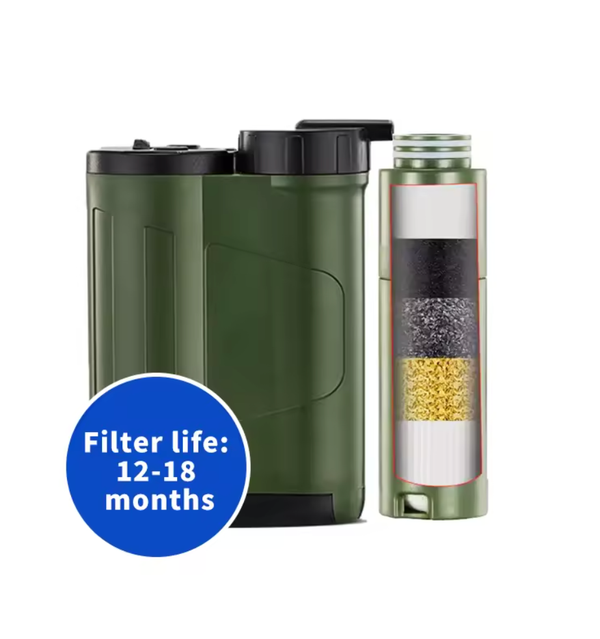
Clean Water Is Not Optional — But Carrying All of It Is⬡ Budget range: $25 – $80 depending on method
Natural water sources look beautiful. Crystal clear streams, glassy mountain lakes, cold springs welling up through ancient rock — none of them are safe to drink without treatment. Giardia, cryptosporidium, and a range of bacterial contaminants live in backcountry water that looks perfectly pristine. The symptoms of giardia last two weeks and are the kind of misery that ends camping trips and ruins the weeks that follow.
Treating water isn't complicated — the technology available today is genuinely impressive. Squeeze filters like the Sawyer Squeeze weigh two ounces and filter up to 100,000 gallons over a lifetime. Pump filters are slower but handle turbid water well. Gravity filters work beautifully at camp without physical effort. Chemical tablets are the lightest backup insurance policy available at any pharmacy. Your water system is one place where buying right means you will never have to buy again.
The Real Lesson About Water
The ability to filter water at the source means you carry dramatically less of it between sources. Instead of hauling four liters over a dry ridge, you carry one liter and treat what you find along the way. Good water filtration is as much about pack weight as it is about safety.
"The best gear is gear you never think about — because it just works, every time, in every condition, without requiring your attention."
The measure of good outdoor equipment07 · Essential🩹
First Aid Kit
The Thing You Hope You Never Need and Can't Camp Without⬡ Budget range: $25 – $50 for a quality pre-made kit
Blisters happen. Cuts happen. Twisted ankles happen. Bee stings happen. The wilderness has a way of finding the minor vulnerabilities in the human body and exploiting them at inconvenient moments, and the nearest pharmacy is frequently a long hike and a longer drive away. A first aid kit is not pessimism — it's the acknowledgment that things happen and that being prepared for them is part of what responsible camping looks like.
A solid pre-made wilderness first aid kit for beginners covers the essentials: adhesive bandages in multiple sizes, gauze pads and roller gauze, medical tape, antiseptic wipes, antibiotic ointment, blister treatment, moleskin, pain relievers, antihistamines for allergic reactions, tweezers for splinters and ticks, and nitrile gloves. Add any personal medications and, if you have a known severe allergy, an epinephrine auto-injector. Keep the kit somewhere you can access quickly, not buried at the bottom of the pack.
Learn to Use It
A first aid kit you don't know how to use is a heavy ziplock bag. Many outdoor retailers, REI, and community organizations offer Wilderness First Aid courses ranging from a half-day introduction to full certifications. Even a two-hour primer changes how confidently you can handle the minor emergencies that are actually common outdoors.
08 · Essential🔧
Multi-Tool or Fixed Knife
The Most Versatile Thing in Your Pack⬡ Budget range: $30 – $80
The number of times a knife or multi-tool is useful at camp is difficult to overstate. Cutting rope, opening packages, preparing food, tightening loose screws on gear, cutting moleskin to shape for a blister, whittling tinder for a fire, cutting medical tape — the uses accumulate daily. The camper without a blade will spend the weekend improvising around the gap.
A multi-tool (Leatherman Wave, Victorinox SwissTool, and their equivalents) adds pliers, scissors, a file, screwdrivers, and a can opener to a knife blade in something that weighs less than half a pound and fits in a belt holster. For car camping and shorter trips, the multi-tool is the more versatile choice. For longer backcountry trips where weight matters more, a fixed-blade knife with a separate small multi-tool gives you the best of both worlds.
The Right Knife
You don't need a survival knife the size of your forearm. A 3–4 inch blade on a multi-tool or a compact fixed knife handles 95% of camp tasks. Bigger knives are heavier, more dangerous in untrained hands, and largely unnecessary unless you're processing large game — which beginners are not doing on their first trip.
09 · Essential🧥
The Layering System
Dressing for Weather You Didn't Predict⬡ Budget range: $80 – $200 for a complete three-layer setup
The wilderness doesn't care about the weather forecast. Mornings are cold, afternoons can be sweltering, evenings cool rapidly, and storms arrive with less warning than the app suggested. The solution isn't bringing every possible piece of clothing — it's understanding how three specific layers work together to handle anything the outdoors throws at you.
The base layer is your skin layer — moisture-wicking synthetic or merino wool that moves sweat away from your body. Cotton is the enemy here. Cotton holds moisture against your skin, dries slowly, and loses all insulating value when wet. The cardinal rule of outdoor dressing is simple: no cotton. The mid layer is your insulation — a fleece or light down jacket that traps warmth. The outer layer is your shell — a waterproof, windproof jacket that protects the layers underneath. You add and remove layers throughout the day as conditions change.
The Cotton Rule
"Cotton kills" is the expression experienced outdoors people use. It is only slightly hyperbolic. Wet cotton against skin accelerates heat loss dramatically and can contribute to hypothermia in conditions that seem mild. Every experienced hiker has a cotton horror story. Don't create yours on your first trip.
Don't forget a warm hat. More heat escapes through an uncovered head than any other part of the body, and a beanie takes up essentially no pack space. Gloves for any shoulder-season trip. And at minimum one complete set of warm, dry clothing kept in a dry bag inside your pack as an emergency layer — never used, never touched unless you absolutely need it.
10 · Essential🎒
The Right Pack
Everything Else Goes Inside This — Choose Wisely⬡ Budget range: $80 – $200 for a properly fitted beginner pack
Every piece of gear on this list needs to go somewhere. The pack is what makes the whole system portable. Get it wrong and it doesn't matter how good everything else is — a poorly fitted pack will destroy your back, your shoulders, your hips, and eventually your enthusiasm for the entire endeavor. Get it right and you will carry forty pounds without thinking about it.
Pack fitting is not something you do online. Go to a store, try packs on, have someone help you adjust the suspension system. The hip belt should sit on your hip bones, not your waist. The shoulder straps should follow the curve of your shoulders without gaps. The torso length — the distance from shoulder to hip — is the critical measurement, and it varies more than you'd expect. A pack that's two inches too long for your torso turns a great day into an ordeal.
Size Guidance
For weekend camping (2–3 nights): 40–55 liters. For car camping where you're driving to the site: size matters less because you're not carrying the weight far. For day hiking: 20–30 liters. Don't buy a 70-liter pack for your first weekend trip — you'll fill it and then wonder why you're carrying so much.
The most important packing tip for beginners: heavy items go closest to your back and high in the pack, between your shoulder blades. This keeps the center of gravity tight to your body rather than pulling you backwards. Light, bulky items go at the bottom. Frequently needed items go in hip belt pockets or the top lid. Your rain jacket goes somewhere accessible because you will always need it when you least expect to.
What This All Costs
A realistic beginner setup — buying smart, not cheap
| 3-Season Tent (2-person footprint) | Quality mid-range option | $120 – $200 |
| Sleeping Bag (20°F synthetic) | 3-season versatile | $70 – $130 |
| Sleeping Pad (self-inflating, R-3) | Comfort + insulation | $40 – $90 |
| Headlamp (200+ lumens) | USB rechargeable | $30 – $50 |
| Camp Stove + Cookset | Canister stove + 1.5L pot | $45 – $80 |
| Water Filter | Squeeze filter + backup tablets | $30 – $50 |
| First Aid Kit | Pre-built wilderness kit | $25 – $45 |
| Multi-Tool | Quality folding tool | $35 – $70 |
| Layering System | Base + mid + shell | $80 – $180 |
| Pack (40–55L) | Properly fitted beginner pack | $90 – $180 |
| Total Range | $565 – $1,075 | |
Buying secondhand gear from trusted outdoor retailers, REI used gear sales, or local outdoor swap meets can cut this total by 30–50%. The gear market for lightly used camping equipment is robust and reliable — most of it has been used only a handful of times by people who bought aspirationally and camped less than they planned.
"The best time to start camping was ten years ago. The second best time is your next available weekend."
Ten items. Every single one earns its weight and its cost. Everything else — the folding tables, the camp shower, the portable espresso maker, the string lights in seventeen colors — is a pleasure you can add once you know you're staying. And you will stay, because camping has a way of solving problems that life outside it creates, and that is something no gear list can fully explain. It has to be experienced.
Print this list. Make a budget. Buy the tent first, because sleeping under real shelter on your first night matters more than almost any other variable. Borrow what you can from friends. Buy secondhand where the risk is low. And then go — because the best gear in the world, sitting in a closet, has never taken anyone anywhere.
The trail is waiting. The weather will not be perfect. You will forget at least one thing. None of it will matter as much as you think it will, and you will be back planning the next trip before the tent has finished drying.